
How AI Is Transforming Modern Cybersecurity
1. The Changing Cybersecurity Landscape
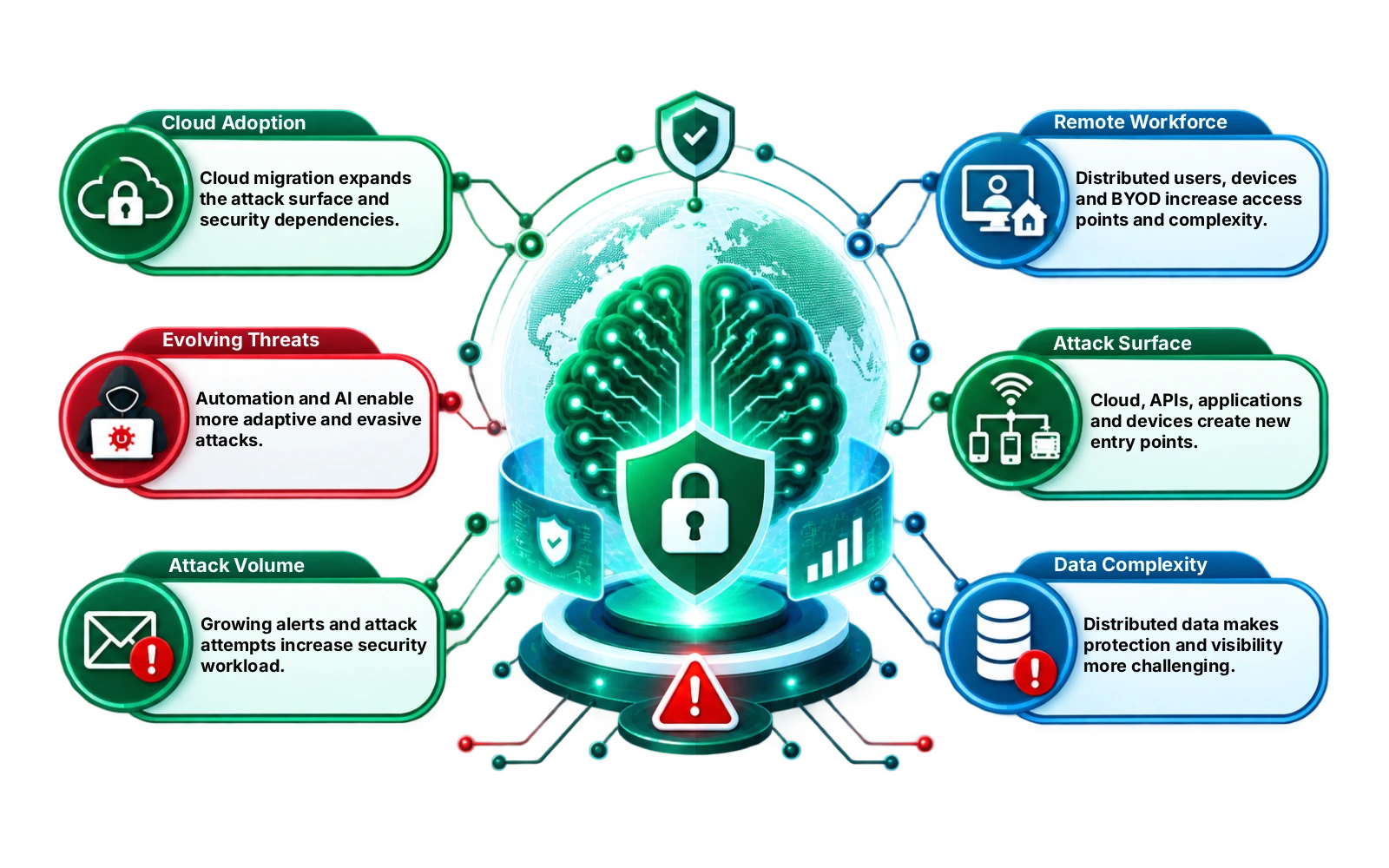
The digital attack surface is expanding rapidly, driven by cloud adoption, remote workforces, and interconnected supply chains. Concurrently, cybercriminals are industrializing their operations, leveraging automation and advanced techniques to execute attacks at machine speed.
Traditional, manual security architectures are no longer sufficient to counter these high-velocity threats. Organizations across industries are struggling with alert fatigue, stretched security teams, and the escalating sophistication of malicious actors.
Artificial Intelligence (AI) has shifted from a conceptual advantage to a critical capability for scaling modern security operations. Utilizing AI effectively allows security teams to move from a reactive posture toward a more proactive and adaptive defense.
2. Where AI Can Strengthen Cybersecurity
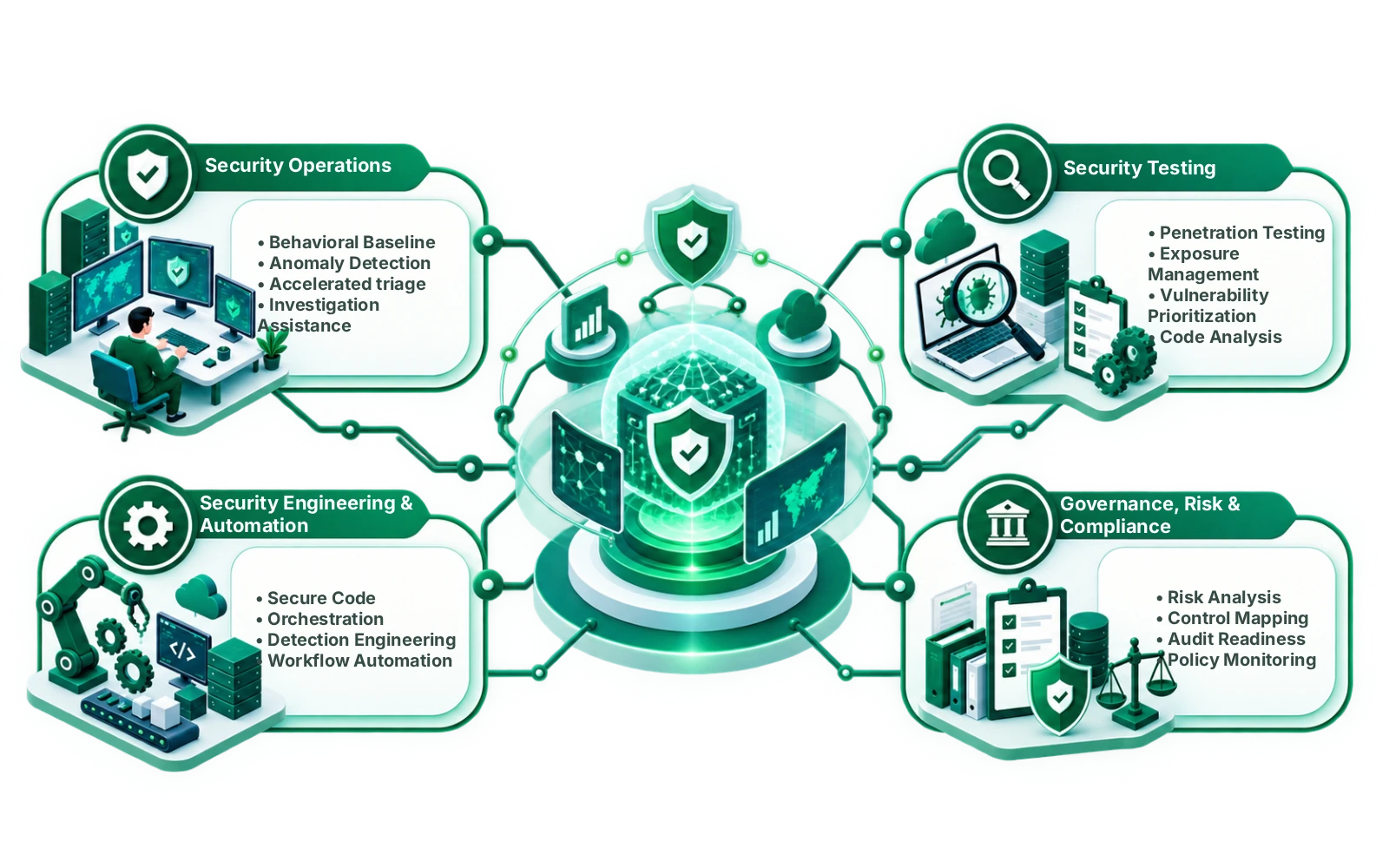
Integrating artificial intelligence across your security framework transforms how you protect digital assets. AI acts as a force multiplier across four core domains of enterprise security:
A. Security Operations
Enterprise Security Operations are frequently overwhelmed by large volumes of telemetry events, where AI can assist in preventing critical blind spots.
- Behavioral Baseline & Anomaly Detection: Machine learning models continuously ingest network flows, endpoint telemetry, and user behavior logs to establish a dynamic baseline of normal activity to streamline anomaly detection.
- Accelerated Triage: AI rapidly detects and correlates subtle anomalies, such as lateral movement, unauthorized privilege escalation, or unusual data exfiltration, substantially reducing mean time to detect (MTTD) and mean time to respond (MTTR).
- Investigation Assistance: AI seamlessly correlates activity across multiple security sources, summarizes relevant evidence, and assists analysts in forming investigation hypotheses and determining appropriate next steps.
B. Security Testing
Proactive security requires continuously evaluating the organization’s security posture from an attacker’s perspective. AI can accelerate testing, expand assessment coverage, and help security teams identify and prioritize weaknesses across increasingly complex environments.
- AI-Assisted Penetration Testing: AI-driven testing capabilities can assist with reconnaissance, attack-path discovery, test-case generation, and vulnerability validation, helping security teams identify weaknesses more efficiently.
- Continuous Exposure Management: AI continuously analyzes assets, vulnerabilities, configurations, and attack paths to identify exposed weaknesses and prioritize areas requiring immediate attention.
- Intelligent Vulnerability Prioritization: Machine learning can assess vulnerabilities against factors such as exploitability, asset criticality, exposure, and business context to distinguish genuine security risks from lower-priority findings.
- Code & Configuration Analysis: AI can analyze source code, Infrastructure as Code (IaC), cloud configurations, and security policies to identify insecure patterns, misconfigurations, and potential vulnerabilities earlier in the development lifecycle.
- Adversarial Security Validation: AI can assist in simulating realistic attack scenarios and validating whether existing security controls can detect, prevent, or contain those attack techniques.
C. Security Engineering & Automation
Scaling security operations efficiently requires minimizing manual overhead through intelligent engineering.
- Secure Code & Architecture Co-Pilots: AI tooling assists engineering teams in identifying insecure coding patterns and misconfigurations in Infrastructure as Code (IaC) templates prior to deployment.
- Advanced Orchestration: Integrating AI into Security Orchestration, Automation, and Response (SOAR) workflows can enable context-aware response and remediation, such as isolating compromised endpoints or revoking compromised credentials based on predefined security controls.
- Detection Engineering: AI streamlines the creation, tuning, and validation of detection rules and telemetry queries, helping security teams rapidly adapt to novel attack behaviors.
- Security Workflow Automation: AI can automate repetitive security processes across vulnerability management, incident response, access management, and security operations, allowing teams to scale security capabilities without proportionally increasing manual effort.
D. Governance, Risk & Compliance
Managing regulatory requirements, internal controls, and organizational risk has become an increasingly complex and continuous responsibility. AI can help transform Governance, Risk & Compliance (GRC) from a largely manual, documentation-driven process into a more connected and continuously monitored function.
- Intelligent Risk Analysis: AI can correlate vulnerabilities, assets, threats, business context, and existing controls to identify emerging risk areas and help security teams prioritize remediation.
- Automated Evidence & Control Mapping: AI can streamline evidence collection, map security controls across multiple frameworks, and align technical telemetry with applicable regulatory and organizational requirements.
- Audit & Assessment Readiness: AI accelerates the audit lifecycle by aggregating documentation, organizing evidence, reviewing control effectiveness, and identifying potential compliance gaps before formal assessments.
- Regulatory & Policy Monitoring: AI can continuously track changes to regulations, standards, contractual requirements, and internal policies, helping organizations understand where changes may affect their existing compliance posture.
3. Getting the Most from Human and AI Collaboration
While AI provides exceptional analytical velocity, cybersecurity remains fundamentally a domain requiring human strategic judgment. Optimizing this synergy is key to operational excellence:
- Mitigating Alert Fatigue: AI can filter noise, correlate related events, and cluster alerts into single, coherent incidents, allowing analysts to focus on high-fidelity investigations and active threat hunting.
- Elevating Consistency: By automating routine investigative steps and providing recommended remediation playbooks, AI bridges internal skill gaps and ensures a consistent standard of defense across the entire team.
- Extending Security Expertise: AI can provide analysts with relevant threat intelligence, historical context, and investigation guidance, helping teams respond more effectively to complex security events.
4. Understanding the Risks of AI in Cybersecurity
To credibly secure an organization, you must also account for how threat actors weaponize these same technologies:
- AI-Augmented Attack Vectors: Adversaries utilize generative models to scale spear-phishing campaigns, generate highly convincing social-engineering content, generate convincing deepfakes for executive social engineering, and assist with reconnaissance, code generation, and attack automation.
- AI-Specific Attack Surfaces: Organizations deploying AI systems introduce new risks, including prompt injection, sensitive information disclosure, insecure outputs, excessive agent permissions, data poisoning, and model and software supply-chain vulnerabilities.
- Model Poisoning and Data Privacy: Introducing sensitive data to unvetted large language models risks proprietary data leakage. Furthermore, poisoned training data can compromise the integrity of machine learning defense models.
- The Expanding Autonomy Problem: As security systems and adversary tools become increasingly autonomous, organizations face risks of unmonitored decision-making loops where rapid automated actions can cause unintended cascading business impacts.
5. Practical Considerations for Adopting AI in Security
When deploying AI-driven security solutions, adhere to structured implementation principles:
- Prioritize Asset Visibility and Data Hygiene: Machine learning models are only as effective as the data feeding them. Ensure comprehensive asset discovery and robust data governance before layering advanced analytics.
- Enforce Zero-Trust Architecture: Pair AI detection mechanisms with strict Identity and Access Management (IAM) and micro-segmentation principles, following a least-privilege approach and continuously validating access.
- Maintain Human-in-the-Loop Oversight: Ensure that high-impact containment actions, such as isolating critical infrastructure or blocking core business services, retain explicit human validation to prevent operational disruption.
- Secure AI Access & Permissions: Apply least-privilege access, strong authentication, monitoring, and clearly defined authorization boundaries to AI systems and agents, particularly where they can interact with sensitive data or security infrastructure.
- Measure Security Outcomes: Evaluate AI deployments based on measurable improvements in detection, investigation, testing, remediation, operational efficiency, and risk visibility rather than simply the number of AI capabilities deployed.
6. Building a More Resilient Security Future
AI is becoming a critical layer of modern cybersecurity, bringing speed, scale, and intelligence to security operations, testing, engineering, and GRC. But the strongest defense combines AI with human expertise, judgment, and control.
The future of security is not replacing humans with AI. It is using AI to make humans faster, smarter, and harder to defeat.